
Acute mortality in sand martins (Riparia riparia) and barn swallows (Hirundo rustica) linked to dermal or inhalation pyrethroid insecticide exposure
Publication category: Research article
Authors: Aafke.I. Saarloos, Maarten J.J. Schrama, S. Henrik Barmentlo, Judith M.A. van den Brand, Natashja M.T. Ennen-Buijs, Reina S. Sikkema, Wouter Bakker, Tijs J. van den Berg, Nico W. van den Brink
Publication date: 2026
DOI: https://doi.org/10.1016/j.enceco.2026.03.019
Language: English
Abstract:
Two acute mortality incidents were studied in colonies of two swallow species (Riparia riparia and Hirundo rustica) in the Netherlands (Utrecht and Noordwijk). The affected birds showed remarkable symptoms of neurological behaviour: proptosis, hypotonia and ataxia. Dead swallows were collected, necropsied and samples taken for a comprehensive virological, pathological and pesticide exposure assessment. Virological tests revealed no evidence for infection and the pathological assessment reported to be cachectic without signs for disease or trauma explaining their death. Screening for 648 pesticides revealed the ubiquitous presence of 2 insecticides, permethrin and tetramethrin, in all extracted feather samples. Permethrin and tetramethrin were absent or detected at relatively low levels in liver and stomach samples, but detected in brain samples. In absence of other plausible explanations, it is concluded that acute neurotoxicity from dermal or inhalation pesticide exposure is the cause of the observed behavioural symptoms and eventually led to the swallows' death. Current risk assessment of chemicals for birds and mammals focusses mainly on oral exposure routes and does not adequately consider the impact of the dermal or inhalation exposure routes. However, the current study demonstrates that these exposure routes can be of crucial relevance for some species or life stages. Knowledge on potential impacts of the dermal and inhalation exposure route is currently lacking which may lead to an underestimation of the risks that pesticide exposure may pose to wildlife.
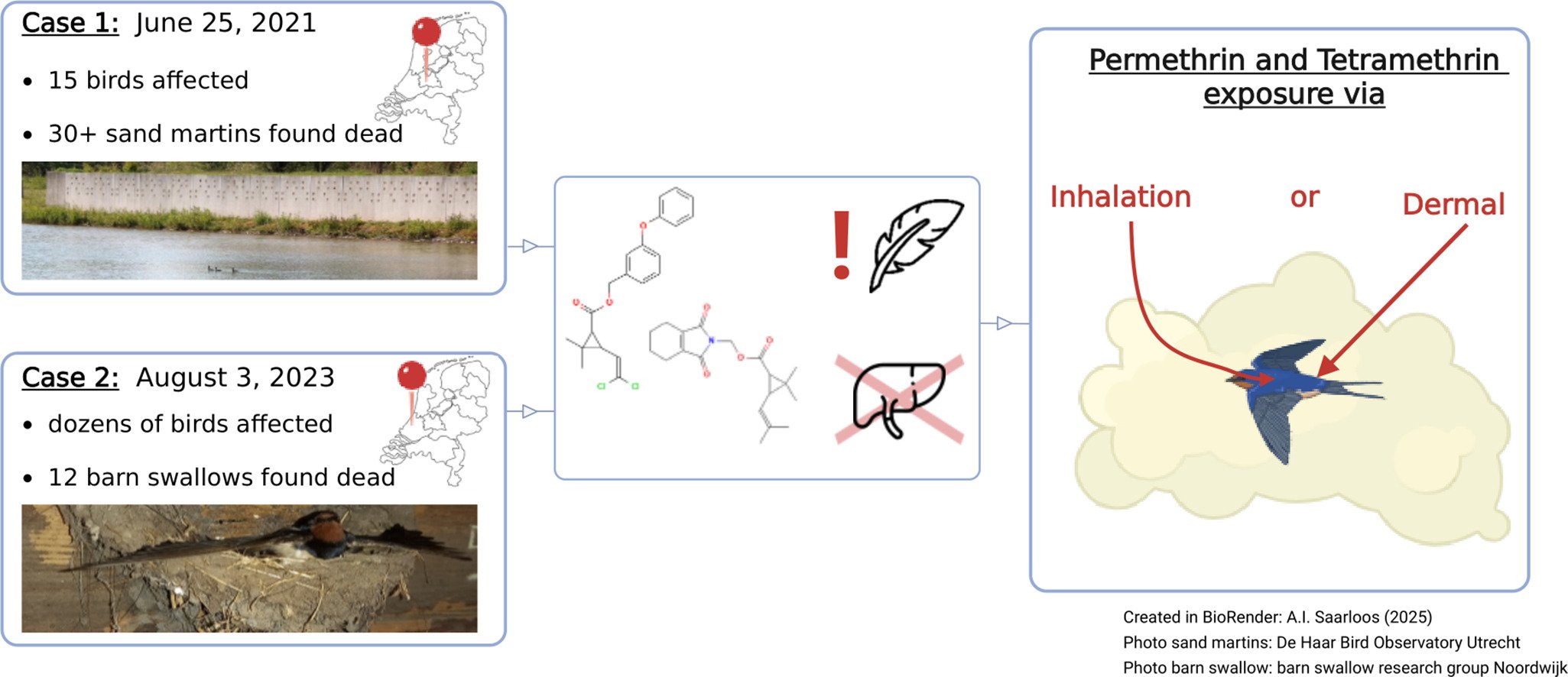
Graphical abstract
Cite this article:
Aafke.I. Saarloos, Maarten J.J. Schrama, S. Henrik Barmentlo, Judith M.A. van den Brand, Natashja M.T. Ennen-Buijs, Reina S. Sikkema, Wouter Bakker, Tijs J. van den Berg, Nico W. van den Brink,
Acute mortality in sand martins (Riparia riparia) and barn swallows (Hirundo rustica) linked to dermal or inhalation pyrethroid insecticide exposure,
Environmental Chemistry and Ecotoxicology,
Volume 8,
2026,
Pages 1779-1786,
ISSN 2590-1826,