
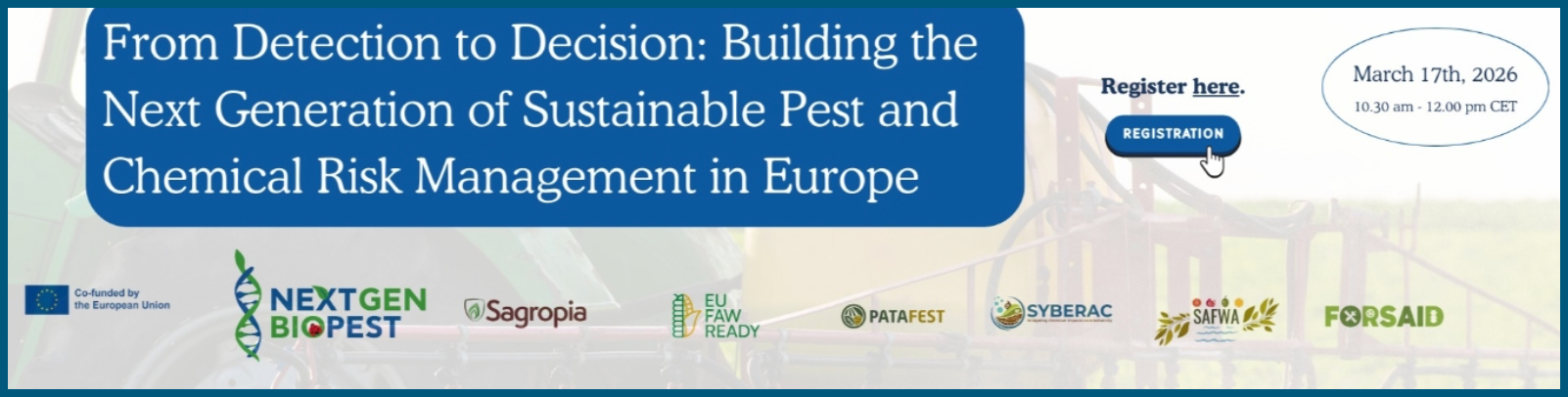
Date: Tuesday, March 17, 2026
Time: 10:30 CET
Duration: 90 Minutes
Format: Online Webinar (Registration Required)
How can Europe protect its crops, forests, and vital ecosystems while drastically reducing its reliance on chemical pesticides? The answer lies in the transition from simple monitoring to intelligent, systems-based decision-making.
SYBERAC is proud to join forces with leading EU-funded projects, including NextGenBioPest, for this specialized 90-minute session. We will explore the integration of high-tech surveillance and novel risk assessment frameworks to build a more resilient agricultural and environmental future.
The Agenda
10:35 | Digital Surveillance & AI Early-Warning Systems – Andrea Battisti (University of Padova, FORSAID)
10:45 | From Single Substances to System-Level Risk – Johan Axelman (Aarhus University, SYBERAC)
10:55 | Expanding the Toolbox Beyond Conventional Pesticides – Deborah Kapantaidaki (NextGenBioPest)
11:05 | Scaling Low-Risk Products in Potato & Sugar Beet – Sara Monteiro (SAGROPIA)
11:15 | Managing Fall Armyworm Outbreaks – Elena C. Ion & Alina Alexa (EUFAWREADY)
11:25 | Sustainable Potato Protection & Postharvest Excellence – Maria de la O Leyva Perez (PataFEST)
11:35 | Making Biopesticides Work: Regulation & Practice – María Teresa Martínez Ferrer (SAFWA)
11:45 | Moderated Panel Discussion:How do detection, risk assessment, and control tools "talk to each other"?
Why Attend?
This webinar bridges the gap between scientific innovation and policy practice. Attendees will gain insights into how digital tools and ecosystem-level modelling are defining the next decade of sustainable plant protection in Europe.
The session will conclude with a joint expert discussion on aligning new tools with European regulatory goals and defining "success" for the 2030s.