What Vulture Pellets Reveal about Veterinary Drugs
A non-invasive method is now helping scientists trace hidden veterinary medicines in the wild.
Previous research within SYBERAC’s Case Study 4B has discovered that vultures are inadvertently exposed to toxic residues when they feed on livestock treated with anti-inflammatory drugs and antibiotics, posing significant risks to these vital ecosystem scavengers.
Monitoring the health of a threatened, massive bird of prey isn't easy. Conventional methods to catch vultures to draw blood are stressful for the animals and expensive for researchers.
Now, 3 scientists Nelly Arlot, Marta Herrero-Villar and Rafael Mateo from UCLM, CSIC, IREC have found out that we can track this exposure without ever stressing or trapping a single bird. They document this in the publication “Tracing Veterinary Pharmaceuticals through Regurgitated Pellets: A Noninvasive Monitoring Approach to Assess Exposure in Avian Scavengers”.
Toxic Veterinary Drugs Threaten Vultures
Our team gathered pellets—natural bundles of indigestible fur that vultures regurgitate, or bring up through their beaks —at specially managed “vulture restaurants” across Spain. They were able to collect 292 pellets from Eurasian griffon vultures and test them for 48 different veterinary drugs. This method offers a scalable, long-term monitoring tool to improve livestock safety policies.
The team discovered that most pharmaceuticals remained highly stable in the pellets for up to a month. Veterinary drugs were detected in 44.2% of the pellets tested. Their analysis also identified mostly traces of antibiotics within the collected pellets. NSAIDs (non-steroidal anti-inflammatory drugs), known as standard painkillers, are found in 2% of the pellets, which are notoriously toxic for vultures. Only a small amount of these drugs can already cause rapid kidney failure and death in vultures. In protection of the scavengers, the disposal of livestock carcasses therefore needs to be closely monitored to ensure that pharmaceutical residues, especially NSAIDs, are not contained.
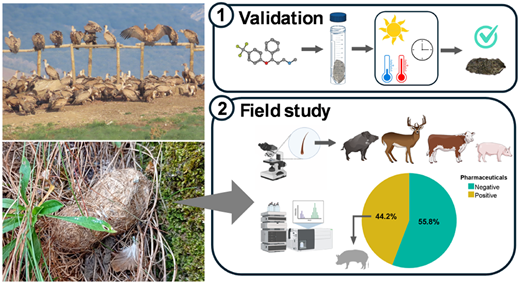
Pig remains were the most common prey associated with the presence of drugs in the pellets. Such pellets made up of domestic livestock remains contained pharmaceuticals much more than twice as frequently (48.2%) than those containing wild animal remains (20%).
A New Holistic Framework to Protect Scavengers
Moving forward, the SYBERAC project aims to integrate these findings into a comprehensive, systems-based environmental risk assessment (sb-ERA). By moving beyond fragmented data, SYBERAC is building a more holistic framework to protect biodiversity, ensuring that the necessary work of agricultural livestock management does not come at the cost of our most iconic natural scavengers.

Photo: Nelly and her team.